

Americans had lived with painful financial cycles throughout their history but the Great Depression was unprecedented in breadth, depth, and duration. Optimistic after World War I, firms over-invested in factories and farmers acquired loans for additional equipment and land. Americans took on consumer debt for the first time. Unregulated banks made risky loans and held inadequate reserves. Investors, including middle-class people, speculated in the stock market. When all of these bubbles burst, economic chaos shook the nation.The stock market plunged on Monday, October 24th, 1929 when about 13 million shares of stock were sold. The damage continued on Tuesday, October 29 when more than 16 million shares were sold, making the day forever known as Black Tuesday. The value of most shares fell sharply, leaving financial ruin and panic in its wake.
By 1932 the United States industrial output had been cut in half. One-fourth of the labor force was out of work and there was no such thing as unemployment insurance. Hourly wages had dropped by about 50 percent. Hundreds of banks had failed. Prices for agricultural products dropped to their lowest level since the Civil War. More than 90,000 businesses failed completely.
In 1933 the new president, Franklin Roosevelt, brought an air of confidence and optimism rallying people to his program, the New Deal. Yet the Great Depression lingered until after December 7, 1941 when the U.S. transitioned to a wartime economy with the onset of World War II.

Neighbors came to depend upon each other and “to neighbor” became a verb. Folks owed debts, but not the kind they could pay off at the bank. They were “beholden’” to their friends and to others who had helped them out. In close-knit La Plata County, everyone understood everyone else’s financial condition. The standard phrase was “Use it up, wear it out, make it do, or do without.”
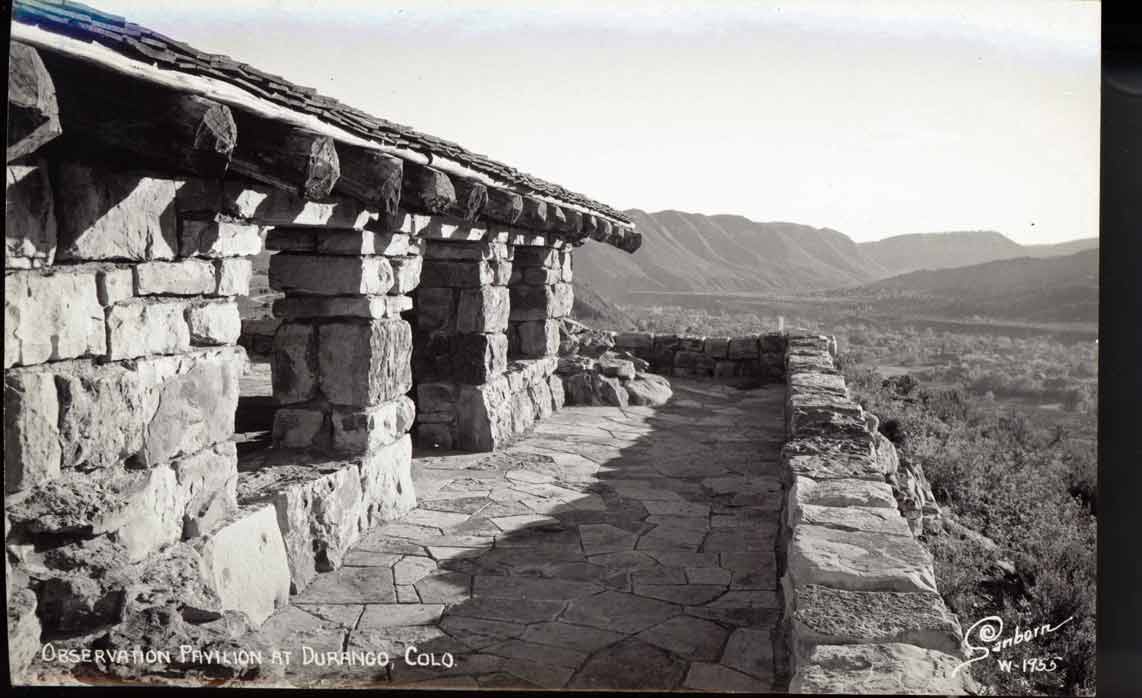
Roosevelt’s New Deal programs brought federal dollars to the area. The Civilian Conservation Corps (CCC) built reservoirs, stone shelters, picnic areas, and worked on erosion control. The county fairgrounds was a Works Progress Administration (WPA) project as was Smiley Junior High and the library at the Old Fort south of Hesperus. Helen Sloan Daniels used National Youth Administration (NYA) funds for archaeological digs in what is now the Crestview area.
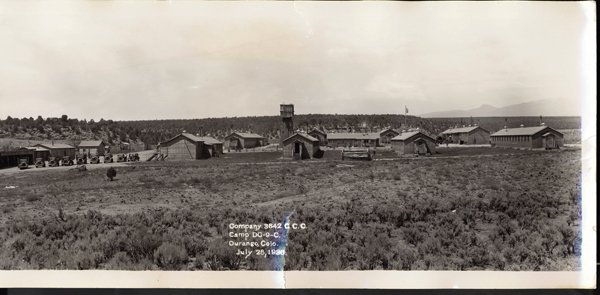
(The image above (catalog number 93.11.1) shows the shelter known as the Lion's Den. It was built by the CCC in the 1930s on Resevoir Hill. The CCC camp is shown in the image below (catalog number 04.28.12) in July 1936.)
The generation that lived through the Depression in La Plata County never forgot. They saved string, newspapers, and cans. Years later they were still “beholden” to their neighbors and proud to help out. They had survived the Great Depression. They could survive anything.
Andrew Gulliford
From the La Plata County Historical Society publication, History La Plata, 2019