A Toast to Suffrage
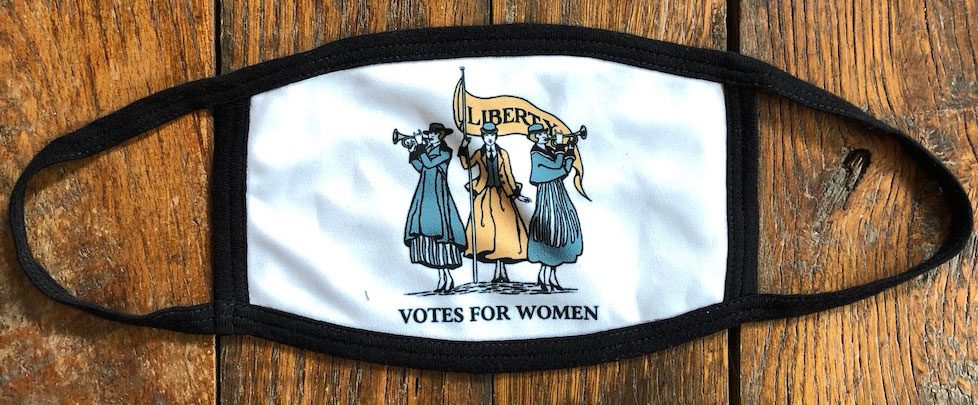
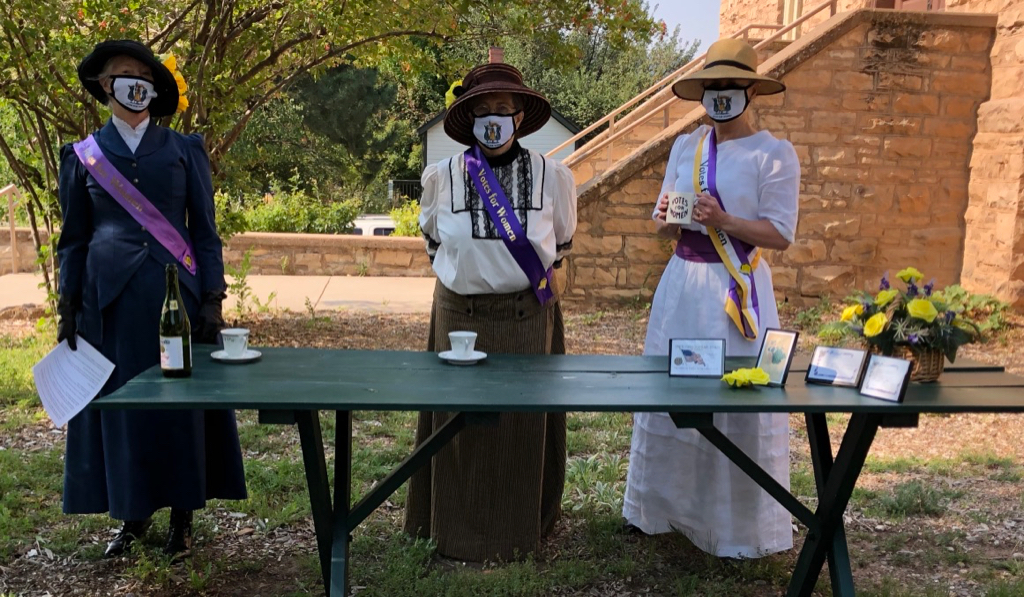
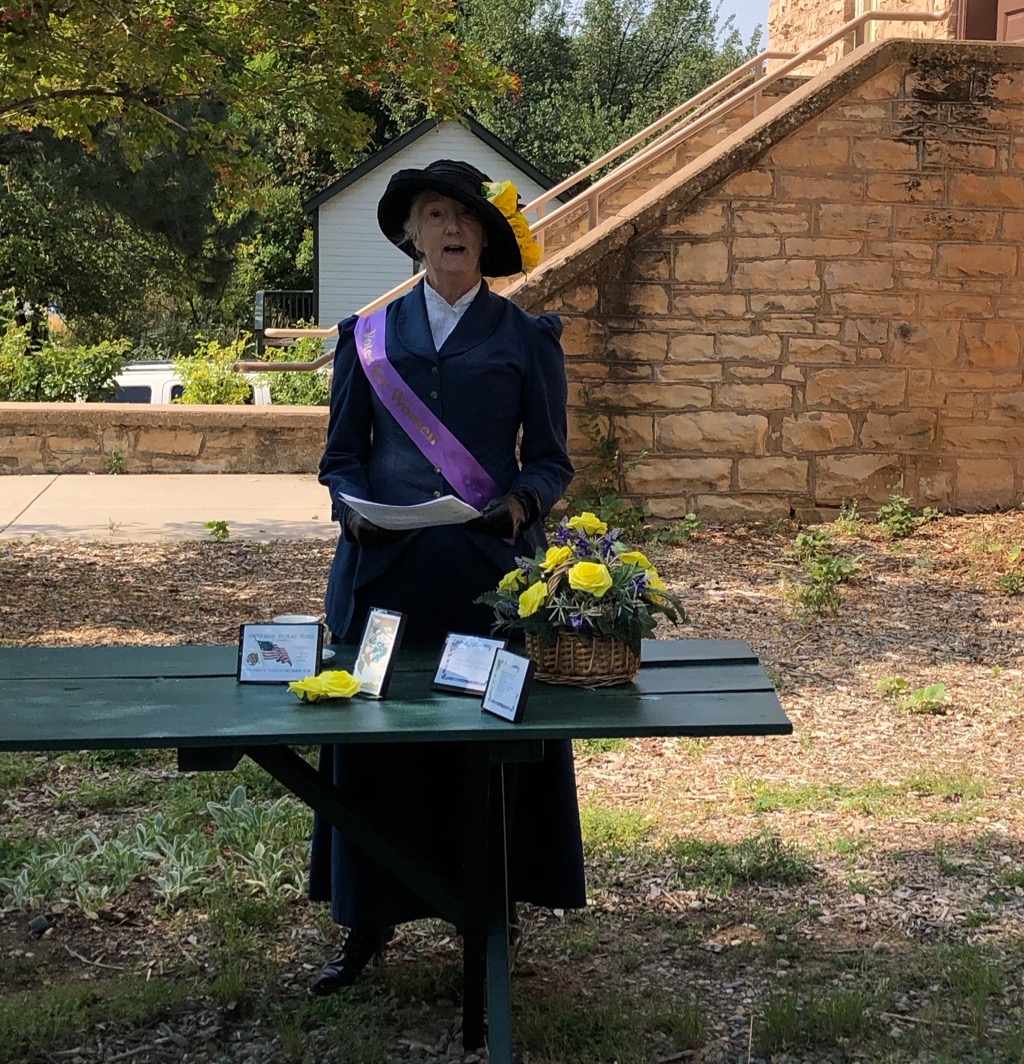
On August 18, the Animas Museum held a safe and socially distant commemoration of the 100th anniversary of the ratification of the 19th Amendment. We wish more people could have been there to share a toast. Here are the speeches.
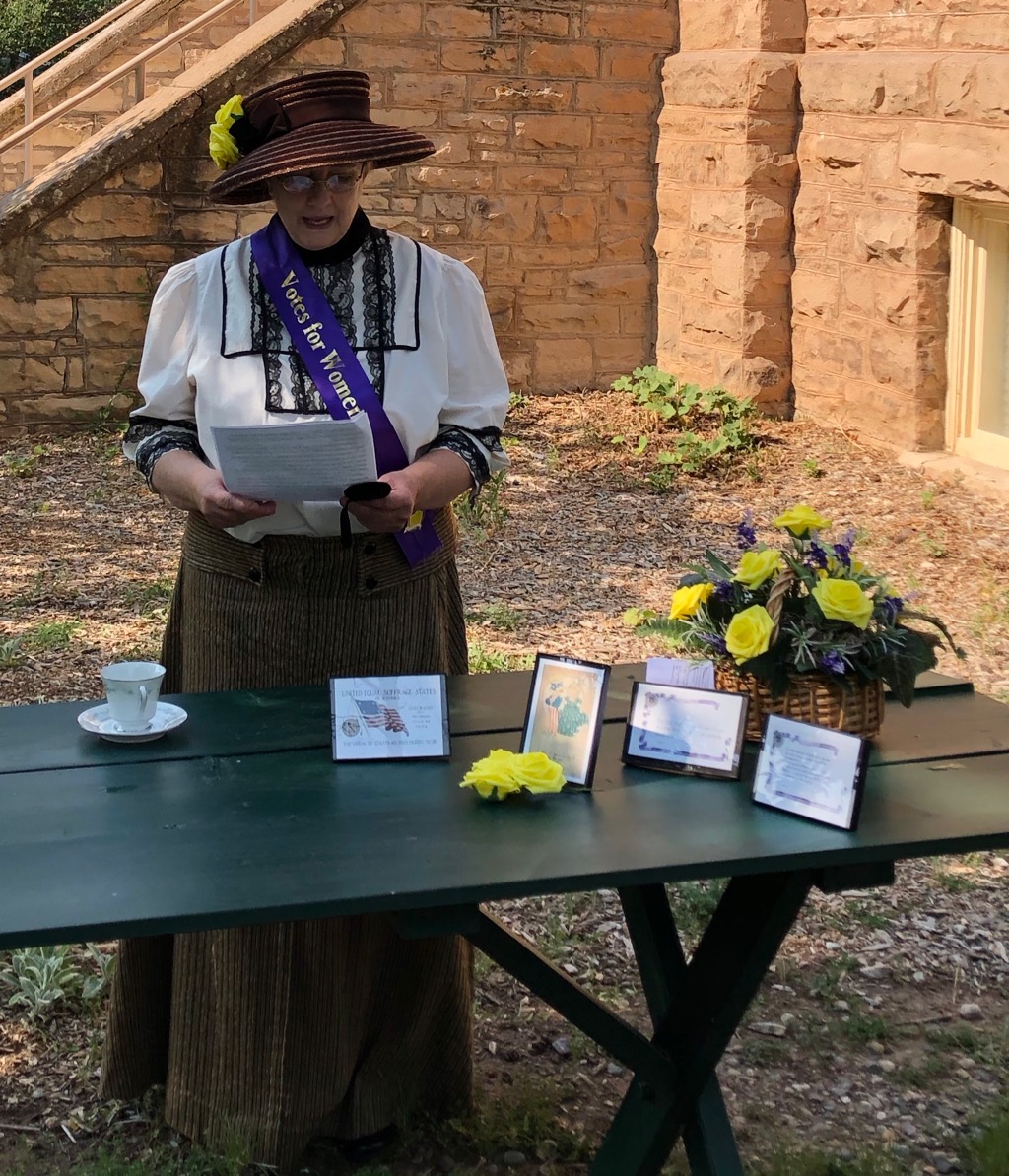
As we celebrate 100 years of suffrage for women, I would like to look back at some key moments in the suffrage movement, so that we may realize how long it took for half of the population of the US to achieve the right to vote.
In the earliest days of our republic the founding fathers determined that states would conduct elections and the founding mothers would not be consulted. 1840 saw women excluded from the World Anti-slavery Congress in London. Reduced to spectators, suffrage leaders resolved to “form a society to advocate the rights of women.”
Eight years later, in July 1848 three hundred attended the Women’s Rights Convention in Seneca Falls, New York. One hundred of the attendees signed the Declaration of Sentiments, which included a call for women’s access to the vote.
In May, 1851 Sojourner Truth gave her now famous “Ain’t I a Woman” speech at a women’s convention in Ohio. Throughout that decade conventions were held annually.
The National Woman Suffrage Association and the American Woman Suffrage Association were founded in May 1869.
Wyoming became the first state to allow women full voting rights in 1890, with women’s suffrage included its constitution. Three years later Colorado became the first state to grant women the right to vote by popular election. 55% of the (all male) electorate approved the measure. Although it is worth noting, it did not pass in La Plata County.
The 19 teens saw The Woman Suffrage Procession through the streets of Washington attacked by mobs. During the WWI years protesters demanding votes for women in front of the White House were arrested and forcefully jailed. Finally, in May 1919 Congress approved the 19th Amendment, sending it to the states for ratification.
At last on August 26, 1920 the 19th Amendment was certified by the Secretary of State, granting full voting rights to women.
Let us raise our glasses to centuries of struggle.
Carolyn Bowra, Museum Volunteer
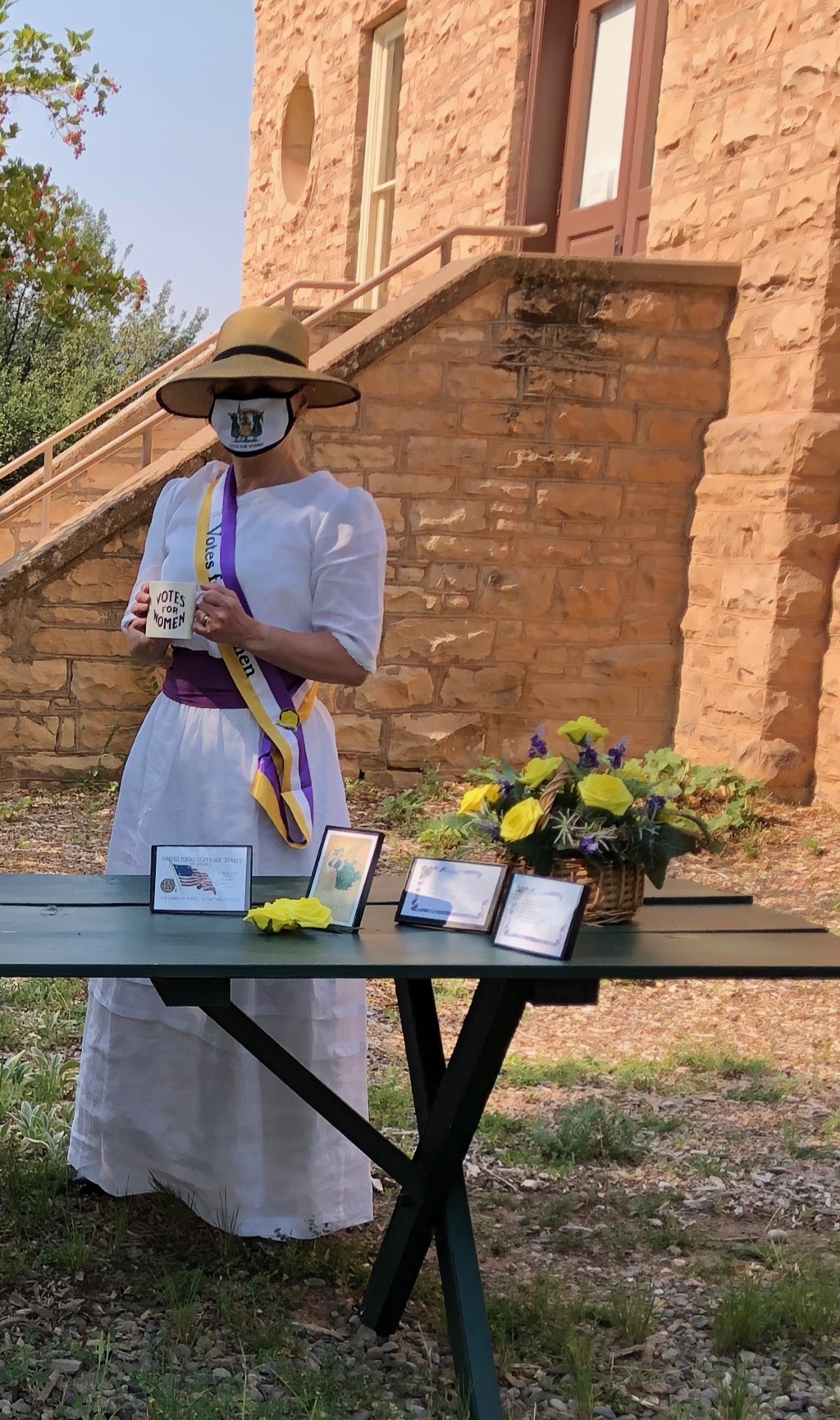
The fight for the right to vote went on for a long time. If we consider the 1848 Seneca Falls convention to the be the start (it wasn’t but we’ll start here) it was 72 years before the 19th Amendment was ratified. Then another 45 years before the Voting Rights Act was signed in 1965 that finally gave all women the rights the 19th amendment implied. There were a lot of women involved. The women who started the fight did not live to see the end. They passed the baton to the next generations of suffragists. Today, we honor and toast them all, even if we don’t have time to mention all of their names.
The first generation included women whose names are familiar, who were active in the abolition movement including:
Lucretia Mott
Elizabeth Cady Stanton
Susan B. Anthony
Lucy Stone
There are lesser known names, Black women were also involved in the fight including:
Sojourner Truth
Frances Watkins Harper, poet and speaker
Ida B. Wells, reporter, anti-lynching activist
We do need to mention Victoria Woodhull, the first woman to run for president in 1872.
Women did start to get the vote before the 19th amendment. After the Civil War, Americans moved West where woman suffrage was more accepted. In Colorado, one year after statehood, an 1877 referendum tried to get women the vote. The women behind that referendum included:
Alida Avery
Albina Washburn
Mary Shields
Susan B Anthony visited in September of that year and rode the newly built narrow gauge railroad, the Denver & Rio Grande. She did not appreciate it. The referendum failed.
Then in 1893 Ellis Meredith of Denver, a “New Woman” and journalist for Rocky Mountain News pushed for a second try when Colorado was controlled by the Populist party. This time a young Carrie Chapman Catt sent by Susan B Anthony. The referendum passed although one Colorado Springs newspaper said “miners voted for it to get women from the East to move out here and marry them." Lillian Hartman was the Durango suffrage representative.
More women from western states had the vote including Wyoming, Utah. Jeanette Rankin of Montana was the first woman to hold federal office, elected to the House of Representatives in 1916. Later, she sponsored the 19th amendment and said “I want to be remembered as the only woman who ever voted to give women the right to vote.”
In the late 1890s, early 1900s the torch was handed to the next generation:
Carrie Chapman Catt and Anna Howard Shaw. Catt became president of the NWSA and Shaw took over when Catt resigned to care for her dying husband. Shaw worked to unite the NWSA with the AWSA. She was a an ordained minister and medical doctor who came to suffrage from the temperance movement. She worked to get a constitutional amendment, preserving Susan B. Anthony’s non-militant stance. Progress was slow.
A new breed of suffragists came in, trained in more militant tactics by Emmeline Pankhurst—Alice Paul and Lucy Burns.
Paul tried new tactics, she organized a suffrage parade in DC in 1913, the day before Wilson’s inauguration.
Rosalie Gardiner Jones hiked from NY to join the march. Inez Milholland led the parade on a white horse.
Paul also sent Sara Bard Field of Oregon to drive cross county, gathering petitions and supporters in a day when few women drove automobiles, let alone from the West to the East Coast.
Shaw retired, turning the leadership of the NWSA back over to Carrie Chapman Catt who remained committed to non-violent tactics. When WWI broke out, Catt agreed with President Wilson to support the war effort ahead of suffrage.
Alice Paul did not agree and started the National Women’s Party.
Alva Vanderbilt Belmont was a major financial supporter.
Harriot Stanton Blatch, daughter of Elizabeth Cady Stanton was a second generation suffragist who joined the NWP.
They proceeded to engage in more civil disobedience for their cause.
The Silent Sentinels, protestors including Alice Paul stood outside the White House with banners starting in January of 1917. At first, Wilson thought it was just annoying. Then the police started to arrest them for “blocking traffic”. Over 100 women were arrested.
Mary Church Terrell was only Black woman to protest. She was not jailed because at that time it was too dangerous for Black women to be jailed.
At one point, 33 women including Paul were arrested and jailed for varying sentences, mostly at the Occoquan Workhouse. There they were badly fed, beaten, denied medical treatment. Some started hunger strikes and were force fed including Paul and Lucy Burns, Lucy Branham, Dora Lewis, Louisine Havemeyer and Sue White.
Sue White was from Tennessee and was was imprisoned for “lighting combustibles on White House grounds.” She burned an effigy of President Wilson which in itself was not illegal but they had to charge her with something. She went on a hunger strike in prison. When the 19th amendment was approved, she went back to Tennessee to use her experience and knowledge of the state to get it ratified. She is one of the reasons we are here today on the 18th of August to toast the 36th state to ratify the 19th amendment. After an uncertain campaign as suffragist and anti-suffragist forces converged on Nashville, the amendment was ratified on August 18th by a single vote. That vote was cast by Henry Burn, the youngest member of the Tennessee General Assembly who went into the chamber that morning wearing a red rose in his lapel, the symbol of the anti-suffragists. At the last minute, he acquiesced to a request his mother, Phoebe Febb Burn had made of him in a letter, to vote in favor of suffrage.
The amendment was ratified, but as we will see, Native American, Black, Latina and Asian women were still kept from the franchise. We also raise our glasses to:
Zitkála-Šá of the Lakota Sioux
Susette La Flesche Tibble of the Ponca tribe
Felisa Rincón de Gautier of Puerto Rico
Patsy Mink first woman Asian elected to congress from Hawaii
Mary McLeod Bethune
Fannie Lou Hamer who tried to vote in 1962 but was denied becaue of claims she was illiterate.
Please visit our website to learn more about these women.
To all of these women and to the millions of others involved in the struggle, we raise our glasses today. Be sure to honor them by voting on (or before) November 3.
Susan Jones, Museum Volunteer
The nineteenth amendment was just the beginning in a series of acts to get many woman the right to vote.
Native American women finally got the vote in 1924 with the signing of the Snyder Act (New Mexico and Arizona didn’t extend voting until 1948).
Asian naturalized women waited until the 1952 with Immigration & Nationality Act to get to vote.
Latinx women faced other barriers especially Puerto Rican women who until literacy tests were finally outlawed in 1975 with an extension to the Voting Rights Act received the full right to vote.
The Voting Rights Act of 1965 removed literacy tests and poll taxes so all Black women could vote.
So now it is 100 years later and how far have we come.
We now have:
127 women out of 535 members serving in the US Congress and in Colorado 44 women out of 100 members of the State congress.
9 female Governors serve in the US.
The US has had a female Secretary of State so far the highest office held by a woman.
We have had Hillary Clinton nominated for president in 2016 and now again a woman vice presidential candidate in 2020.
Woman make up 50.8 percent of the population and they make up 59% of the voters.
Here in LaPlata County 59% of females as a share of the voter population voted in November 2018.
There are 8 groups working nationally on voter registration. Top among those is the League of Women Voters a non partisan organization that works on registration and voter education. At the suggestion of Carrie Chapman Catt the League formed Feb14,1920 only 6 months before the final ratification of the 19th amendment. The Colorado League of Women Voters is led by Karen Sheek, former mayor of Cortez.
Colorado has a nationally recognized Secretary of State, Jana Griswold, who continues to help Colorado have one of the highest percentage of voter turn outs as the 72.1% of 2016 shows. Registration in Colorado may be done online or at drivers license offices making for ease of registration for women.
But many women, especially low-income women, struggle to take time off to get to the polls because Election Day is still not a national holiday, and when they finally arrive, they’re often met with hours long lines and broken machines. Transgender women are rejected at polls because the name or gender marker on their IDs does not match how they present. Immigrant and Indigenous women still face many hurdles before getting to the ballot box.
Again Colorado is in the forefront with mail in voting where any working woman with two children, who might not be able to miss work or carpooling to school or Scouts, can vote by marking her ballot and mailing it or putting in several ballot locations in town. Mail in voting has been successful for Colorado and any one who has been down to the Tiffany Parker at our County Clerk’s office and seen the many steps to vote verification can see why the fraud rate is only 0.0025% as established by the non profit organization The Electronic Registration Information Center (ERIC) Making Colorado one of the most secure states in which to vote.
So my toast is to women like Tiffany Parker, Jana Griswold, and Karen Sheek who keep woman voting. Oh and the men too! It isn’t about exclusion but true inclusion in the democratic process.
Gay Kiene, LPCHS Board of Directors